
Dhaka North’s New House Rent & Tenant Guidelines: A Clear Breakdown for Tenants and Landlords
Dhaka’s rental market has always been a bit… chaotic. Sudden rent hikes, unclear rules, verbal agreements, and constant disputes have made life difficult for both tenants and landlords. To bring order to this system, Dhaka North City Corporation (DNCC) has announced a new set of house rent and tenant guidelines aimed at regulating rent increases, improving safety, and reducing conflicts.
These directives were announced on 20 January at DNCC Nagar Bhaban by DNCC Administrator Mohammad Azaz, and are said to be aligned with the House Rent Control Act, 1991. DNCC’s message is straightforward: rental rules must be clearer, fairer, and more enforceable—because most Dhaka residents are tenants, and housing costs have become a major burden.
Why DNCC Introduced These Guidelines
DNCC highlighted the pressure Dhaka faces due to migration, job opportunities, and Dhaka-centric services. With millions living as tenants, rental disputes have become a daily reality.
They also pointed out a long-standing problem: even though the House Rent Control Act, 1991 exists, enforcement and clarity have been weak. That’s why DNCC is pushing clearer instructions—so rent, access, safety, and documentation don’t depend on “who says what,” but on defined rules.
The Biggest Changes You Should Know (Quick Summary)
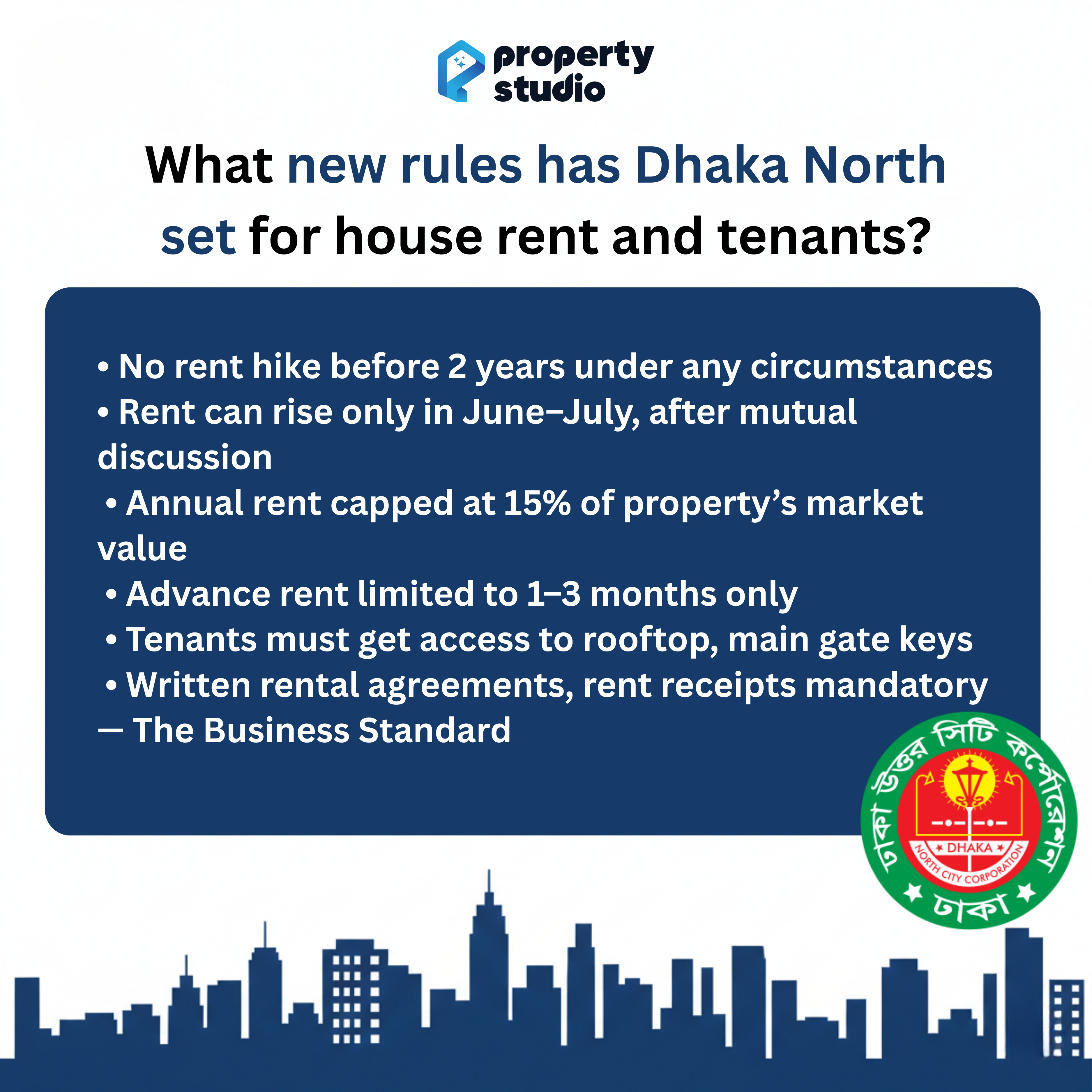
Here are the key rules DNCC has emphasized:
- No rent hike before two years once a reasonable rent is fixed
- Rent can be revised only during June–July, and only through mutual discussion
- Annual rent capped at 15% of the property’s market value
- Advance rent limited to 1–3 months
- Tenants must receive conditional access to the rooftop and main gate keys
- Written rental agreements are mandatory
- Monthly rent receipts are mandatory
- Ward- and zone-level bodies will handle landlord–tenant disputes (with escalation options)
Now let’s break these down in plain language.
1) No Rent Increase Before Two Years
This is the headline rule.
Once a “reasonable rent” is agreed upon, it must remain unchanged for at least two years. According to the guideline, rent cannot be increased “under any circumstances” before this period.
What this means in real life
If you rent a flat today at Tk X, the landlord should not increase it next month, after six months, or even after one year. The rent becomes stable for two years—giving tenants predictability and reducing fear-based pressure.
2) Rent Can Increase Only in June–July (And Only Through Discussion)
Even after the two-year period, DNCC says rent increases should happen only during June–July and must be settled through mutual discussion.
Why this matters
This rule aims to stop random mid-year increases. It creates a “rent revision season,” so negotiations happen at a predictable time—and ideally in a calmer, more structured way.
3) Annual Rent Cap: 15% of Market Value
DNCC has also included a ceiling: the annual rent should not exceed 15% of the property’s market value.
What this intends to do
This is meant to discourage unrealistic rent pricing. In a market where rent often feels disconnected from reality, DNCC is trying to introduce a benchmark tied to actual property value.
4) Advance Rent: Only 1–3 Months Allowed
One of the most common tenant complaints in Dhaka is excessive advance payments. DNCC’s guideline says landlords cannot take more than one to three months’ rent as advance.
Why this matters
For many tenants—especially families, students, and new jobholders—high advances can be a huge barrier. A cap makes the entry cost more reasonable and reduces financial pressure.
5) Rooftop & Main Gate Keys: Tenants Must Get Conditional Access
This part is strongly linked to safety.
DNCC says tenants must receive conditional access to:
- the building rooftop, and
- the main gate keys
DNCC’s reasoning includes emergency risks like fire, earthquakes, and other disasters where access routes matter.
“Conditional access” — what does that mean?
It doesn’t mean tenants can do anything anytime. It means access should be possible when needed, especially for safety and emergency situations. Restrictions can exist—but access cannot be completely blocked.
Also: if a landlord plans to introduce security measures, tenants should be informed in advance and their opinions should be considered.
6) Habitability and Utilities: Landlords Must Ensure Basic Services
The guidelines reinforce a simple standard: the house must remain habitable.
Landlords are expected to ensure services like:
- gas
- electricity
- water
- regular waste collection
If there’s a problem, tenants should inform the landlord, and the landlord should resolve it promptly.
7) Rent Payment Deadline + Mandatory Receipts
DNCC’s guideline says:
- Tenants should pay rent by the 10th of every month
- Landlords must provide a written receipt every month
This is a big shift for Dhaka, where many rent payments happen without any proof.
Why receipts matter
Receipts protect both sides:
- Tenants can prove they paid
- Landlords can track payments clearly
- Disputes reduce dramatically when proof exists
8) Written Rental Agreements Are Now Mandatory
No more “verbal deal + handshake.”
DNCC says rental agreements must be written and clearly include:
- rent amount
- advance amount
- rent increase conditions
- notice period for leaving
This single rule can prevent a huge number of disputes, because it forces clarity upfront.
9) Ending the Agreement and Non-Payment Rules
Ending a tenancy
For residential buildings, either party may terminate the agreement with two months’ notice.
If rent isn’t paid regularly
DNCC suggests a step-by-step approach:
- verbal warning
- written notice
- tenant may be asked to vacate within two months
This creates a documented process instead of sudden eviction threats.
10) Dispute Resolution: Ward & Zone Bodies Will Step In
To handle conflicts without instantly turning everything into a “big fight,” DNCC proposes:
- Ward-level and zone-level landlord–tenant associations to resolve disputes locally
- If unresolved, the issue can go to the area’s regional executive officer
DNCC also plans zone-based consultation meetings to raise awareness and encourage compliance.
What You Should Do Next (Practical Checklist)
If you’re a tenant
✅ Ask for a written agreement (or update an old one)
✅ Always request a monthly receipt
✅ Clarify rooftop/gate access rules as “conditional access”
✅ Keep proof of payments and notices (photos or PDFs)
If you’re a landlord
✅ Use a standard written agreement format
✅ Create a simple receipt system (paper or digital)
✅ Communicate security/access rules clearly
✅ Try ward/zone mediation first to reduce conflict
Final Thoughts
DNCC’s new guidelines are basically trying to turn Dhaka’s rental culture into something more predictable: stable rent periods, documented agreements, fair advances, safety access, and structured dispute resolution.
If these rules are followed seriously, they could reduce stress for tenants and also protect landlords from misunderstandings and messy disputes. The biggest win is clarity—because most rental problems in Dhaka come from one thing: everything being informal.
Expert insights from the Property Studio team on property management, real estate, and digital solutions.